


1. IMSLP (Petrucci Music Library) — The Classical Gold Standard
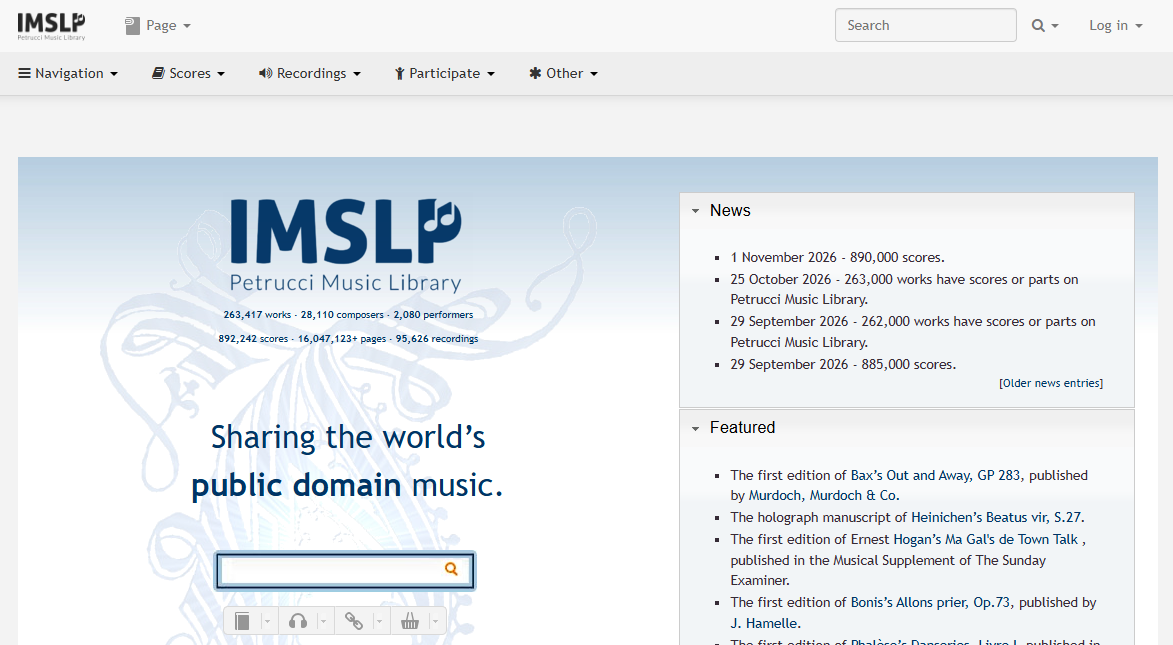
Ask any classical player where they get free sheet music, and IMSLP is always the first name out of their mouth. With over 263,000 works and 892,000+ scores, it’s massive. Need five different editions of Chopin’s Nocturnes to compare fingerings and phrasing? They’re all sitting on the same page, mostly as music sheet PDF files alongside community recordings.
The catch is that the site still looks like a 2006 Wikipedia page, and non-members have to sit through a 15-second countdown timer before every sheet music download. Also, since tons of uploads are scans of old 19th-century books, quality is hit-or-miss. Always scroll down and look for files tagged “Typeset” if you want crisp printable music sheets instead of crooked, yellowed scans.
2. MuseScore — Best for Modern Covers
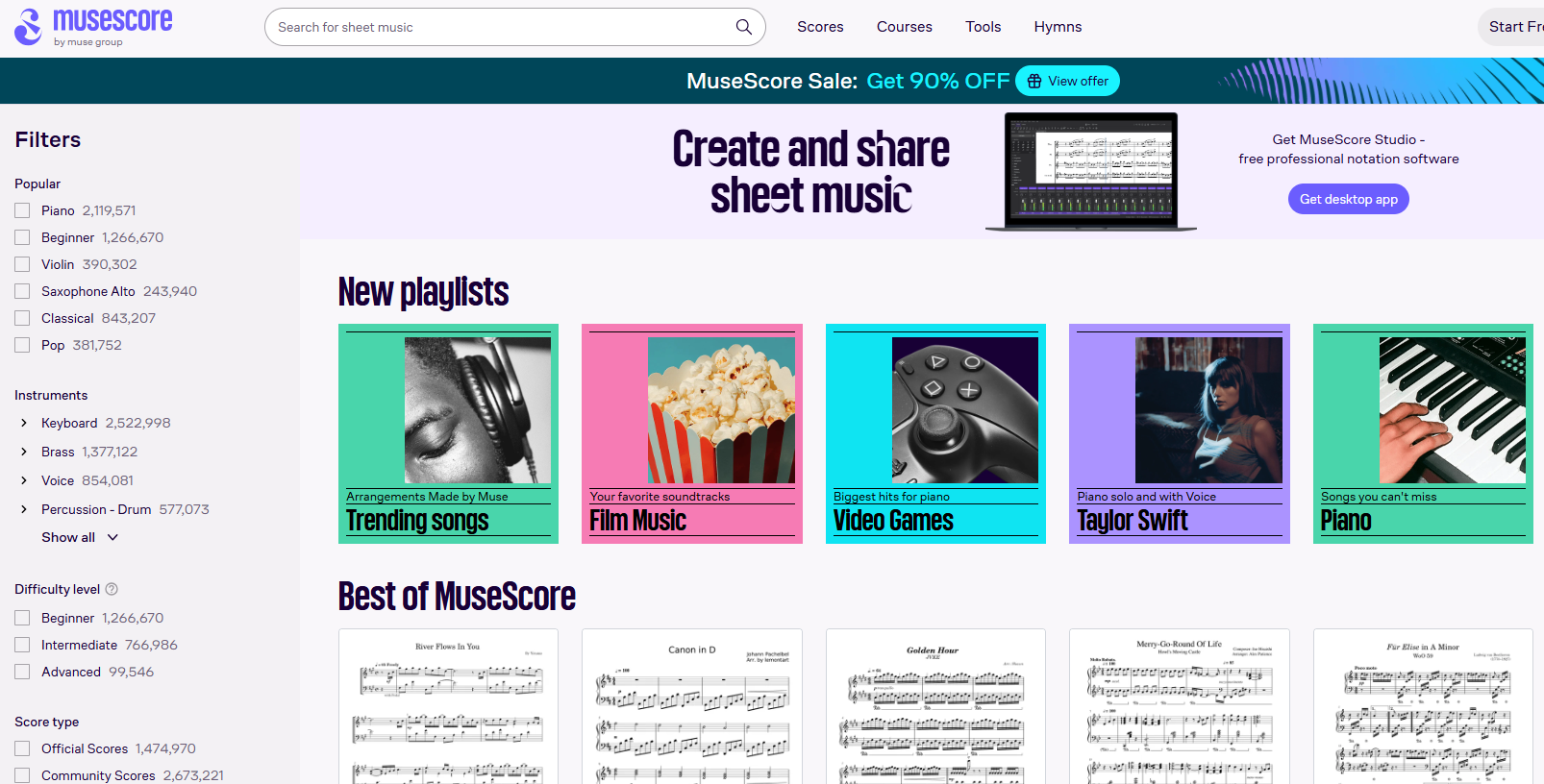
Whenever you need a piano sheet music PDF for a movie soundtrack, jazz standard, or video game theme, MuseScore is easily the biggest community-driven free sheet music site around. Unlike static PDF libraries, MuseScore lets you play the score right in your browser—you can mute the left hand, slow down a tricky run, and loop four bars while practicing.
Just be ready for its confusing paywall setup. Because MuseScore licenses copyrighted songs from publishers like Hal Leonard, “Official” scores require a Pro subscription. That said, hundreds of thousands of public domain pieces, original compositions, and Creative Commons arrangements are still totally free. Click the “Free” or “Creative Commons” filter on the left sidebar right away so you don’t waste clicks on locked scores, then grab your sheet music download in PDF, MSCZ, MusicXML, or MIDI.
Bonus Tip: Fixing Scanned PDFs & Loose Image Files Before You Print
Grabbing free sheet music from archives like IMSLP or independent arrangers on Reddit often leaves you with two annoying file issues: scanned PDFs with non-selectable foreign lyrics, or scores shared as separate JPG or PNG images per page. If you need to pull Italian tempo notes or German vocal lyrics out of a vintage scan for program notes, run the file through an online OCR—this multi-language sheet music OCR tool converts scanned PDFs and score photos into editable Word, Excel, PDF, PowerPoint, Markdown, or TXT files in one click (though if you want to turn the musical notes themselves into playable MIDI, you’ll still need a dedicated notation scanner like Soundslice). And if you downloaded a stack of loose JPG or PNG pages that print with weird margins, drop them into online JPG to PDF to batch-convert each image into its own clean, standard-sized music sheet PDF ready for US Letter printing or iPad apps like forScore.
3. Mutopia Project — Best When You Hate Blurry Vintage Scans
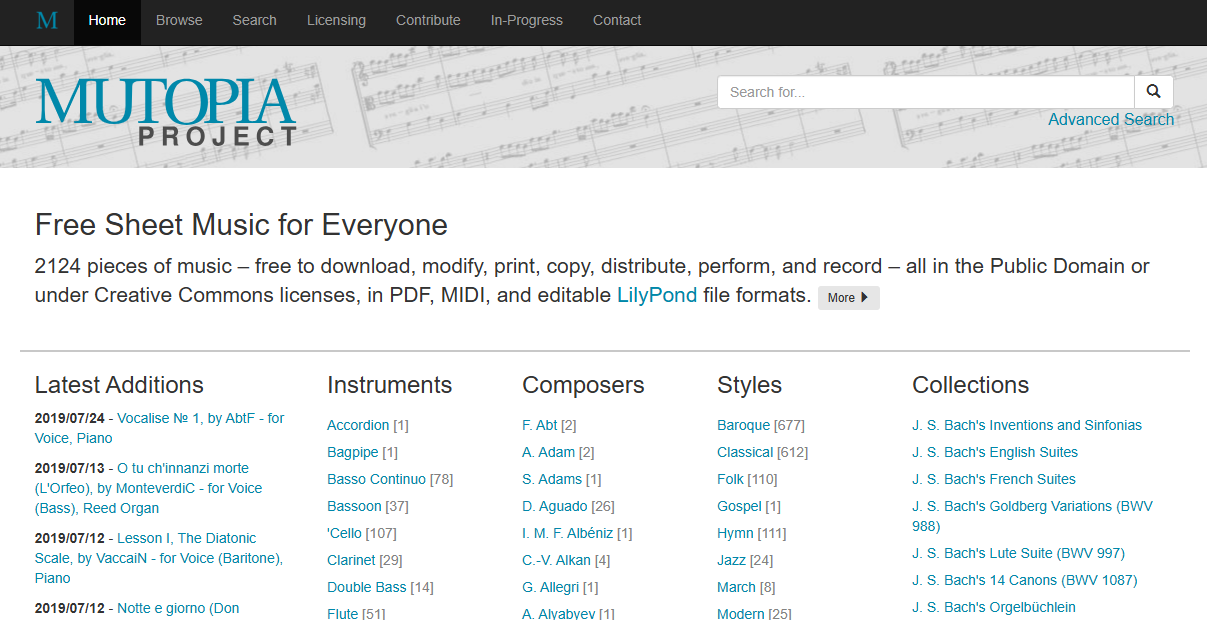
IMSLP has everything, sure, but printing an old 1890 scan eats through printer toner and leaves grey smudges all over the page. That’s where the Mutopia Project shines. Every single piece in its catalog—around 2,100 classical works, hymns, and folk songs—is freshly typeset by volunteers using GNU LilyPond.
The engraving looks sharp right out of a home printer. Better yet, Mutopia gives you separate music sheet PDF downloads pre-formatted for US Letter and A4 paper, plus MIDI and editable LilyPond files, so margins never get chopped off.
4. 8notes — Best for Beginners
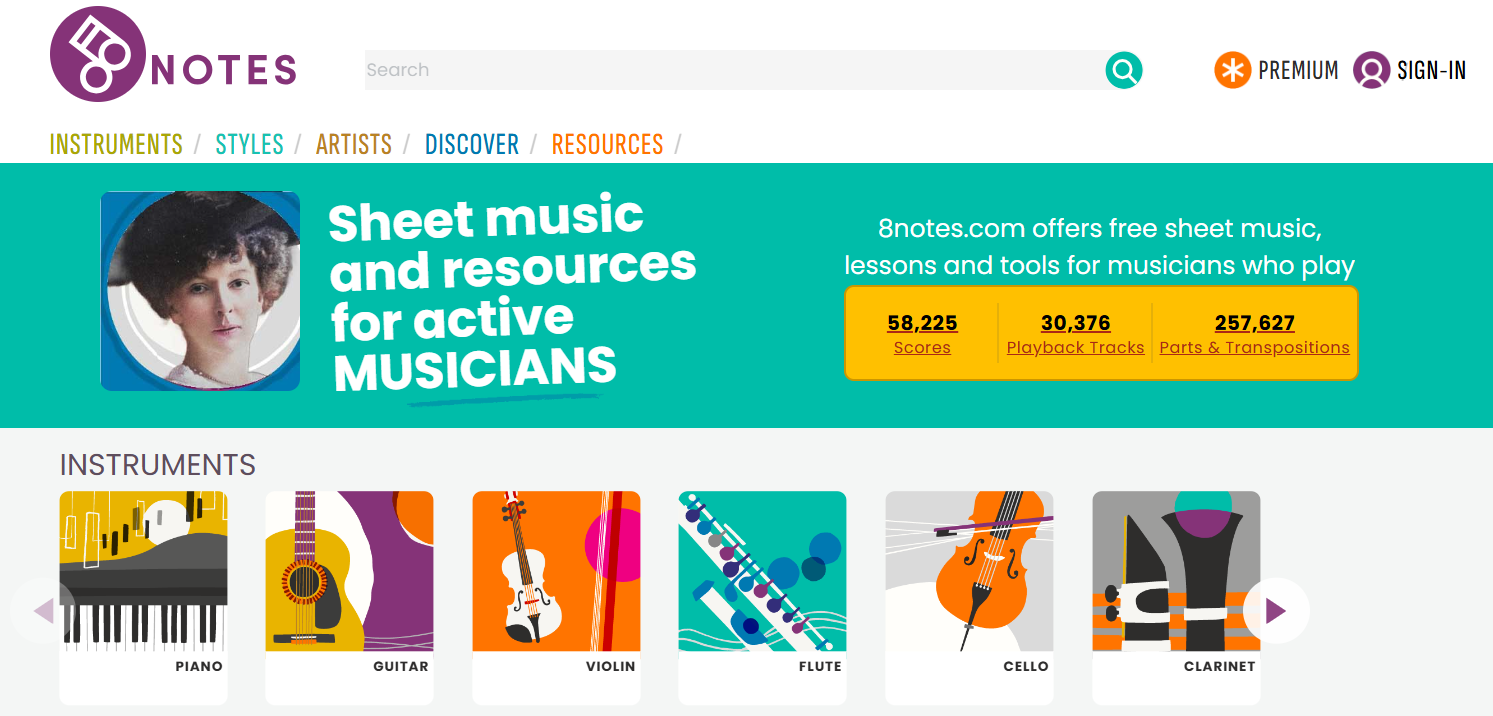
Throwing a beginner into IMSLP is a fast way to overwhelm them. 8notes goes the opposite route: everything is sorted by instrument, style (classical, jazz, folk, pop, holiday), and skill level from Beginner to Advanced, with backing tracks built in.
One underrated perk here is transposition. If you play alto sax, clarinet, or trumpet and want a tune originally written for flute or piano, 8notes often has the transposed music sheet PDF ready to go. All free pieces are either in-house public domain arrangements or properly licensed educational sheets, making it a safe bet for students and band teachers.
5. BandMusic PDF Library — Best for Concert Bands & Wind Ensembles
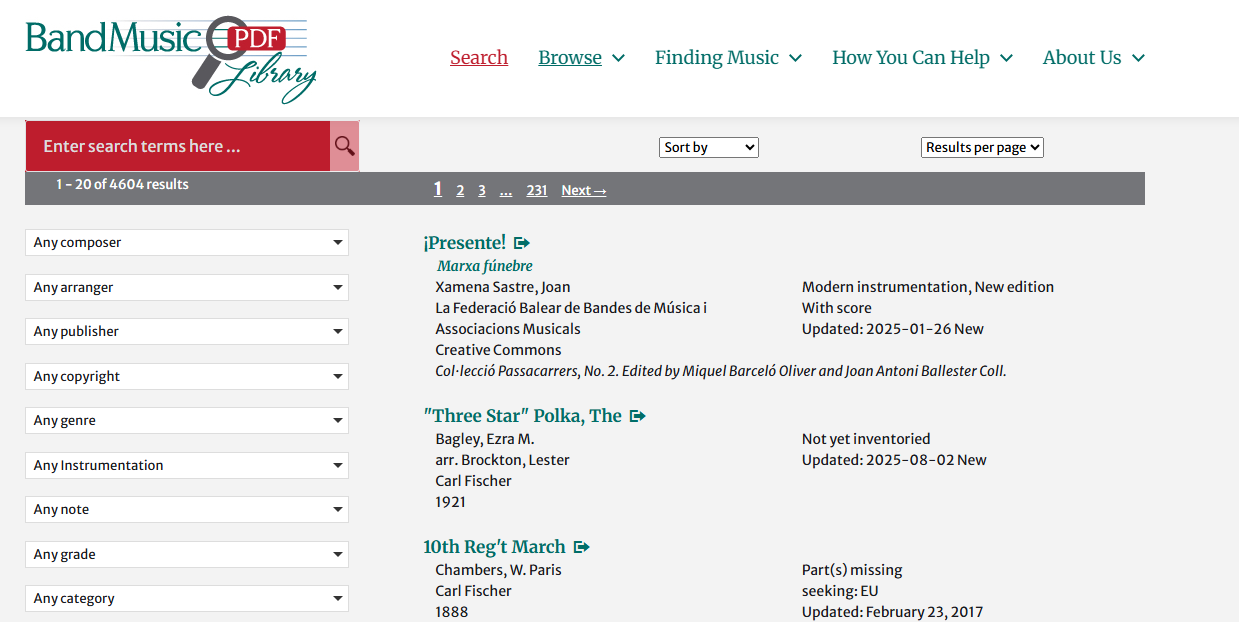
If you play in a community band or teach school wind ensemble, BandMusic PDF Library is a goldmine. Running online since 2006, this volunteer-run archive hosts over 4,600 public domain marches, waltzes, ragtime classics, and instrumental solos with band accompaniment. Unlike piano-heavy sites, every entry lists exact instrumentation details and difficulty grades so you can download complete, printable music sheets for brass, woodwind, and percussion sections in one go.
6. CPDL — Best for Choirs & Vocal Groups
Buying 40 copies of a choral octavo gets expensive fast. Choir directors rely on the Choral Public Domain Library (CPDL) because it hosts over 45,000 public domain and freely licensed vocal scores, from Renaissance motets to traditional folk songs. You can filter specifically by voicing (SATB, SSA, TTBB) and grab rehearsal MIDI files along with English translations of Latin, German, or Italian texts.
Best Legal Free Sheet Music Sites
| Platform | Primary Repertoire | Download Formats | Account / Cost Notes | Key Limitation |
|---|---|---|---|---|
| IMSLP | Classical, Opera, Orchestral | PDF, MP3 | Free (No account needed) | 15-second download wait; vintage scan quality varies |
| MuseScore | Pop, Anime, Games, Jazz | PDF, MSCZ, MusicXML, MIDI | Free account required | Official licensed pop scores require Pro; filter by “Free” |
| Mutopia Project | Classical, Hymns, Folk | PDF (US Letter/A4), MIDI, LilyPond | Free (No account needed) | Smaller catalog (~2,100 works), mostly solo/small ensemble |
| 8notes | Beginner Classical, Band, Jazz | PDF, MIDI, MP3 | Free tier available | Some advanced/popular arrangements require membership |
| BandMusic PDF Library | Concert Band, Marches, Ragtime | PDF (Full Band Parts) | Free (No account needed) | Focuses strictly on pre-1931 wind band repertoire |
| CPDL | Choral & Vocal Ensembles | PDF, MIDI, MusicXML | Free (No account needed) | Wiki-style navigation takes time to learn |
Google Search Tricks to Find Hard-to-Locate Scores
Built-in search bars on big music archives can be notoriously picky about spelling, opus numbers, and translated nicknames. Whenever an archive’s own search comes up empty, try searching through Google instead.
Adding a site filter followed by the archive’s name and the piece’s nickname—like searching for “Raindrop Prelude” specifically inside IMSLP—usually works way better than the site’s native search bar, because Google handles typos and nicknames effortlessly. If you want to skip blog posts and paid storefronts altogether, tack a PDF file-type filter onto the end of your search (for example, searching for Clair de Lune piano sheet music filtered strictly to PDFs) so Google only pulls up direct music sheet PDF files. You can also use that same site-specific search trick on well-known community video game and anime sheet music archives to track down fan-transcribed piano sheet music PDF arrangements shared legally by those communities.
Common Questions Musicians Ask
• Wait—is downloading free sheet music actually legal, or am I pirating?
It’s completely legal as long as the piece and that specific edition are in the public domain (in the US, anything published in 1930 or earlier is fair game as of 2026) or the arranger shared it under an open Creative Commons license. Sites like IMSLP and Mutopia check copyright status before unlocking a sheet music download. What crosses the line are sketchy file-sharing sites hosting scanned Hal Leonard or Alfred songbooks—steer clear of those.
• Can I actually find free piano sheet music PDFs for current pop hits?
Full studio transcriptions of Top 40 songs are locked down by publishers, so you won’t find official versions for free on legit sites. Your best legal workaround is filtering by “Free” on MuseScore to grab fan-made arrangements, checking 8notes for simplified melodies and chord charts, or looking in the description boxes of YouTube piano cover artists who link their own printable music sheets.
• Why do half the IMSLP downloads look like crooked photocopies, and how do I clean them up?
Because many of them are scans of 19th-century books. Before you hit download, scroll down the IMSLP work page and look for an entry labeled “Typeset”—those are clean, computer-engraved scores that print nicely right out of the box. If an old scan is your only option, bump up the contrast setting in your PDF reader before printing so the grey background drops out, or run the music sheet PDF through MuseScore Studio’s built-in PDF converter to rebuild the notation digitally.
• I downloaded a score in the wrong key—can I transpose a PDF?
Not directly inside a standard PDF viewer, because PDFs treat notes as static drawings rather than pitch data. If you need to change keys, go back to MuseScore or CPDL and grab the MusicXML or MSCZ version instead. Open that in the free MuseScore Studio desktop app, highlight everything, and use the transpose tool in the top menu. If you play band instruments like alto sax or clarinet, 8notes also hosts pre-transposed printable music sheets so you don’t have to do it manually.


Leave a Comment