


Part .1 | Top 5 Research Title Generators
Summarizing months of methodology, data, and findings into a single line is often harder than writing the paper itself. When you are stuck looking at a blank doc, a specialized research project title generator helps bridge the gap between a broad topic and a polished headline. Here is how the leading platforms perform in practice.
1. LightPDF AI Agent
If you’ve ever used a basic title tool, you know the drill: you type “AI in education,” and it gives you “A Study on AI in Education.” Totally useless. LightPDF AI Agent works completely differently. Instead of relying on dumb keyword-matching, it reads through your whole outline or draft first. Then, it pulls out your actual variables and method to write titles that sound like real journal submissions.
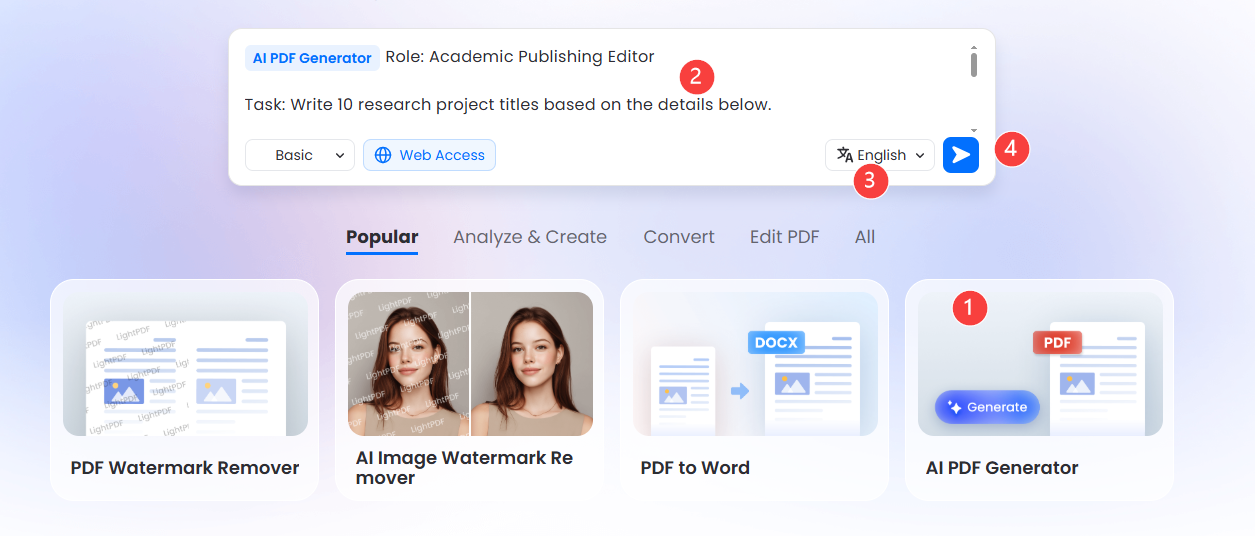
How to Use:
- Open the online AI Agent and jump into the AI PDF Generator tab.
- Dump your rough project context, research method, and key questions into the prompt area.
- Choose your language, click Send, and let it build a list of options.
Prompt Template:
Role: Academic Publishing Editor
Task: Write 10 research project titles based on the details below.
Topic: [Insert Topic, e.g., Generative AI in Higher Education]
Methodology: [Insert Method, e.g., Qualitative Case Study / Quantitative Survey]
Target Population: [Insert Group, e.g., Undergraduate Students]
Format Requirements: Include a balance of descriptive, declarative, and two-part colon formats (Topic: Subtopic).
2. iLoveNote Research Title Generator
Need a title in five minutes because your proposal portal closes at midnight? iLoveNote is built for pure speed. No account creation, no paid pop-ups—just a straightforward web tool where you drop in tags and get immediate suggestions.
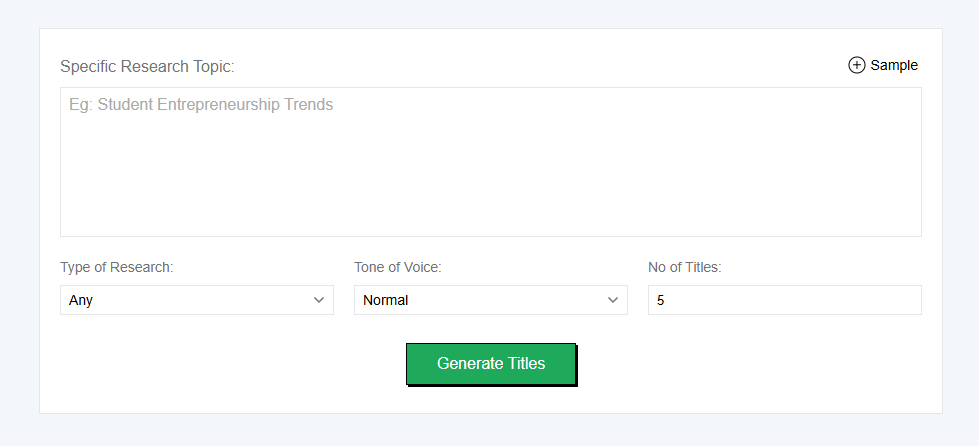
How It Works & Workflow:
- Tag Input: Type in your primary topic and select a methodology tag from the dropdown list.
- Filter Setup: Pick your subject area (like Social Sciences or STEM) and select an overall tone.
- Instant Output: Hit generate, grab a few variations, and polish them yourself.
The Honest Truth:
- Zero Barrier: 100% free with no annoying registration screens.
- Fast Mapping: Connects broad topics to standard research frames fast.
- The Catch: The outputs can feel a bit repetitive if your research is super specialized. It’s great for quick inspiration, but don’t expect it to do all the heavy lifting.
3. Paperguide AI Academic Title Generator
Dissertation committees are notorious for hating vague titles. Paperguide AI is specifically designed for serious academic papers, tailoring word choices and formatting rules to fit specific disciplines and peer-reviewed journals.
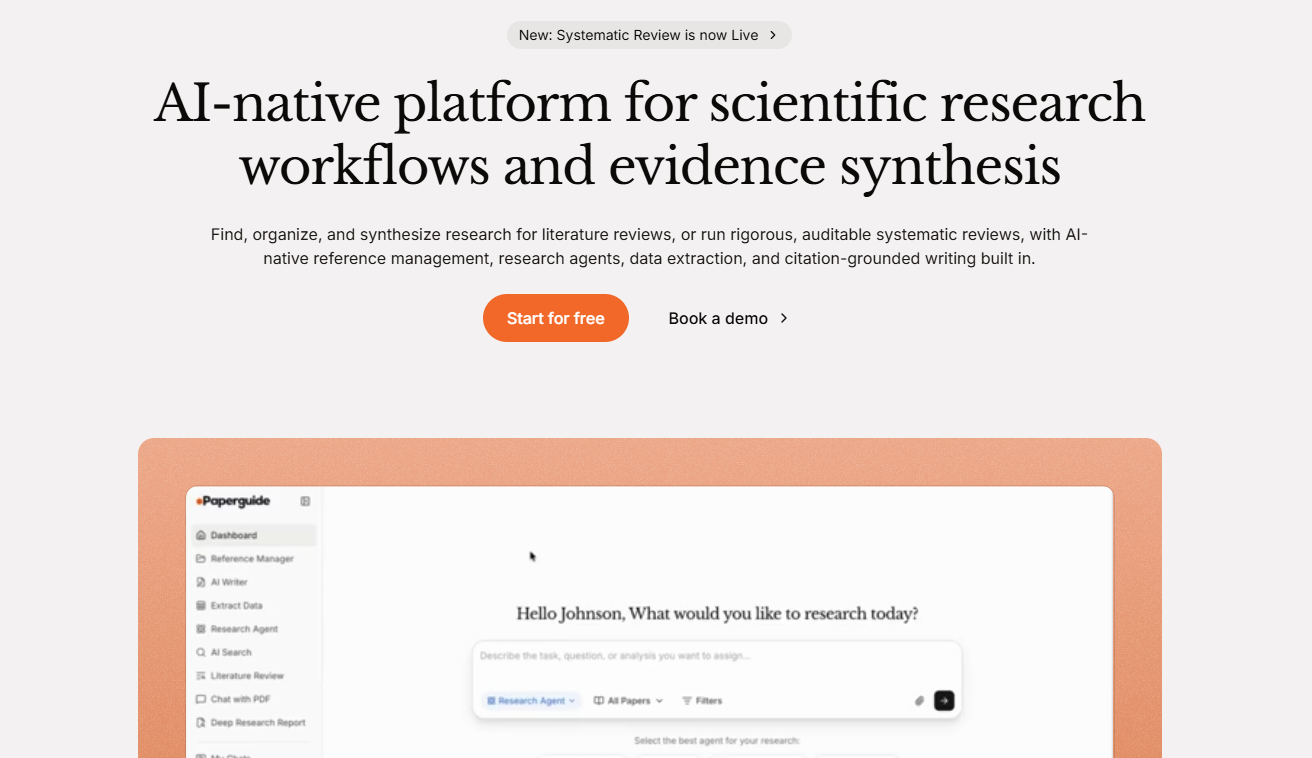
How It Works & Workflow:
- Context Setup: Enter your general topic idea, core research methods, and exact field of study.
- Tone Selection: Choose formatting rules designed for STEM, Social Sciences, or Humanities.
- Format Toggles: Switch between declarative statements, questions, or classic colon-separated titles (Topic: Methodology).
The Honest Truth:
- Field-Aware: It actually knows the difference between a psychology title and a bioengineering headline.
- Committee-Friendly: Focuses on standard academic formulas that clearly state your variables and population.
- The Catch: It garbage-in, garbage-outs. If your own research scope is vague, the titles it generates will be just as blurry.
4. EduBirdie Research Title Generator
EduBirdie provides a dedicated, topic-categorized research title maker designed specifically for university assignments and term papers. Rather than relying on open-ended text prompts, it uses pre-configured academic categories (such as Literature, Business, Medicine, or Technology) to structure your inputs according to standard essay and paper types.
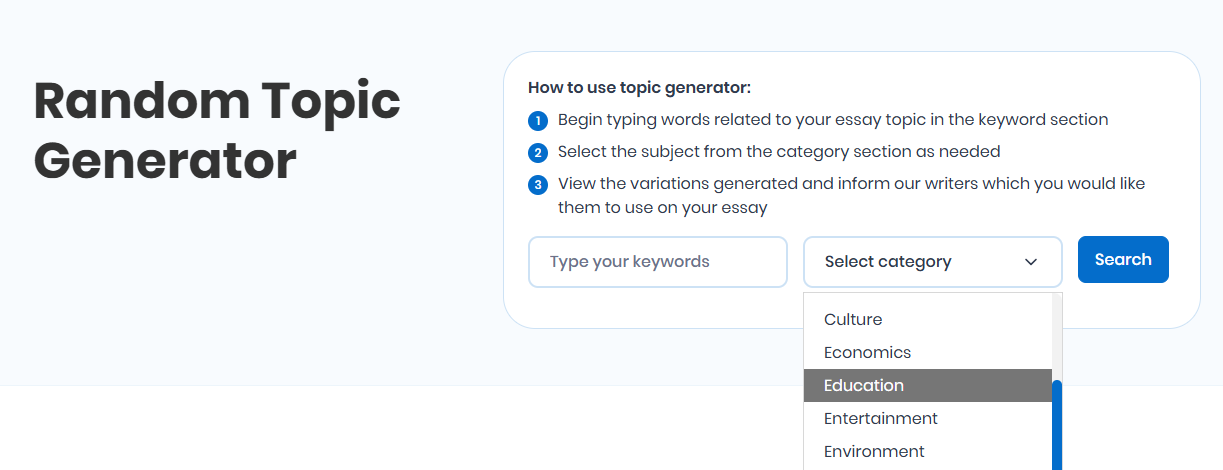
How It Works & Workflow:
- Topic Selection: Pick your specific academic subject area and paper type from the dropdown lists.
- Keyword Entry: Type in your primary research topic or core subject focus.
- Category Generation: Click to receive a list of filtered, topic-aligned title suggestions.
The Honest Truth:
- Category-Driven: Helps narrow down vague ideas by aligning them with specific field categories.
- No Signup Required: Free web-based tool for quick coursework inspiration.
- The Catch: It produces traditional, template-style titles. You will likely need to adjust the output if your project requires a highly technical or unique methodology.
5. Writefull Title Generator
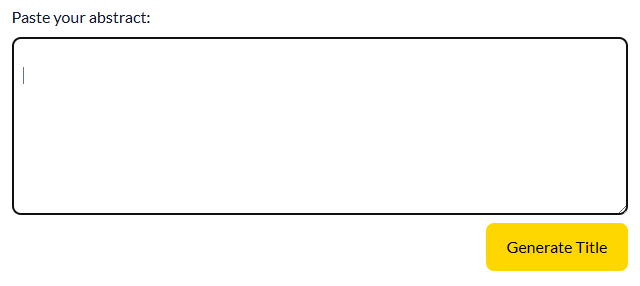
If you’ve already written your abstract, don’t waste time typing keywords into basic name generators. Writefull was trained directly on millions of published journal articles and extracts titles straight from your draft paragraphs.
How It Works & Workflow:
- Paste Abstract: Drop your raw abstract, introduction, or executive summary into the box.
- AI Extraction: The tool analyzes your text to identify your core findings and research methods.
- Refinement: It returns titles structured like those in real scientific databases.
The Honest Truth:
- Abstract-Driven: You don’t need to guess tags—it reads what you actually studied.
- Journal-Ready: Matches the exact phrasing styles used by major scientific publishers.
- The Catch: You need a finished abstract draft first. If you’re still in the early brainstorming phase, this tool won’t be much help.
Part .2 | Tool Comparison Matrix
| Tool | Core Input | Customization Level | Best For |
| LightPDF AI Agent | Outline / Prompt context | High | Complex thesis proposals & custom formatting |
| iLoveNote | Keywords & tags | Medium | Late-night, low-effort brainstorming |
| Paperguide AI | Field & topic details | High | Academic thesis & dissertation proposals |
| EduBirdie | Topic category & keywords | Medium | Quick coursework & term paper titles |
| Writefull | Full paper abstract | High | Journal manuscript submissions with existing drafts |
Part .3 | FAQ
What essential elements belong in a research title?
Keep it simple: variables, target population, and methodology. If you leave one out, your title usually sounds vague. For example, “Evaluating Remote Learning Adoption Among STEM Undergraduates: A Mixed-Methods Study” tells the reader infinitely more than “A Study on Online Schooling.”
How long should an academic title be?
Aim for 10 to 15 words. Titles under 8 words rarely give enough technical context, while titles over 18 words get cut off in academic database searches and look messy on cover pages.
How do quantitative and qualitative research titles differ?
Quantitative titles highlight measurable metrics, variables, and statistical testing (e.g., “The Impact of Sleep Duration on Academic Performance”). Qualitative titles focus on lived experiences, contexts, and social frameworks (e.g., “Exploring First-Generation Student Adaptations to Campus Life”).
Can I use these generated titles directly in my final paper?
Yes, but always run them past your department’s style guide (APA 7, IEEE, or MLA). AI tools frequently mess up title-case capitalization, hyphenation rules, or specific university formatting guidelines.


Leave a Comment